Sunday, October 24, 2010

Pumpkin & Feta Savory Muffins


This recipe is for pumpkin-lovers with a curious streak... it's pumpkin not in a pie or dessert, but in a savory muffin (more of a biscuit, actually) with scallions and salty feta cheese.


As a side note, I've included a method for roasting a pumpkin yourself (versus using canned). It's actually really easy as long as you have some extra time.


I was happy with how these turned out, but they almost smelled better as they were cooking-- they sort of smelled like Thanksgiving in a muffin.

Lastly, I used whole-wheat flour in this recipe in an effort to use the lesser-processed option, but you could also use white all-purpose flour. The whole-wheat version seemed to make the muffins a little denser than I was expecting, so I would be curious what a half-and-half version would be like.


Pumpkin & Feta Savory Muffins


Makes 20-22

2 C chopped roasted pumpkin pie pumpkin (or other winter squash)
1 large handful of spinach, chopped (about 1 C)
1/2 C unsalted sunflower seed kernels
1 t Dijon mustard
3/4 C feta cheese, crumbled
1/2 C Parmesan cheese, shredded or grated
1 t salt
1/2 t ground black pepper
1 t red pepper flakes
4 t baking powder
2 C whole-wheat flour (can also use all-purpose flour)
2 eggs
3/4 C milk
1 bunch of scallions/green onions, chopped (about 1 1/4 C)
1 T butter or olive oil to grease muffin tins

1. To roast the pumpkin:

Preheat oven to 400 F. Slice pumpkin open and scoop out seeds. Cut pumpkin into about eight chunks. Leaving skin on, place pumpkin pieces in a pan and put about 1/4-inch of water in the bottom of the pan. Place in oven for about 40-45 minutes; test tenderness of pumpkin with a fork.

Once pumpkin is done, set aside to cool. The oven can stay at the same temperature to cook the muffins.

2. While pumpkin is cooking, grease the muffin tin with butter or olive oil (I actually used coconut oil, which is a good alternative to butter).

3. In a large mixing bowl, combine the spinach, scallions, sunflower seeds, Parmesan, a half-cup of the feta, the mustard, salt, red pepper flakes, and pepper. Add the chopped pumpkin.

4. Beat the eggs and milk together in a separate bowl, and add to the pumpkin mixture. Sift the flour and baking soda into the pumpkin mixture and fold all together.

5. Spoon the mixture into the greased muffin tin, filling each tin about 3/4 full. Sprinkle the remaining feta over muffins. Bake for about 15 minutes (still at 400 F), until the tops and sides of the muffins are brown. Let sit for a few minutes before cooling on a cooling rack.


Adapted from a 101cookbooks.com recipe.

Sunday, October 17, 2010

The Ecological “Footprint” of Eating Meat

Meat, the key ingredient of so many classic American dishes, can seem like a staple in the US. Most people’s first mental image of American food is probably a hamburger or meatloaf, right? Yet, for those who eat meat, should it be considered more of a luxury or indulgence?


http://www.esquire.com/features/cooking-perfect-steak

Aside from the ethical reasons that lead many people to abstain completely from eating meat, there are numerous environmental reasons to consider what the “footprint” of meat production is compared to that of non-meat alternatives. And, just as importantly, what the “footprint” is of the particular type of meat being eaten.


http://www.topnews.in/pay-higher-cost-water-after-overhaul-2264713

One way to look at this is to compare the resources (water and various forms of energy) required to produce meat versus that required to produce other types of food—meat’s ecological footprint.

At least one study has shown that a non-vegetarian diet is more of a resource drain than a vegetarian one is. For instance, Marlow et al found that a vegetarian diet utilized significantly less water, primary energy, fertilizer, and pesticides in comparison to the non-vegetarian diet. The biggest difference between the two diets was water usage: they found that a non-vegetarian diet required about 264 additional gallons of water a week for production in comparison to a vegetarian diet. Of note, though, is that the differences in the two diets resulted primarily from an inclusion of beef (versus other types of meat) in the non-vegetarian diet (p. 1701S).

The table below shows how three groups of food compare in terms of the calories that result in the actual food that’s eaten per each calorie of energy (fertilizer, etc) that is required to produce that food. While cereal grains and legumes provide more nutrient calories than the calories of energy that it took to produce them, “animal products” only return 0.01 or 0.05 of each calorie of energy that was used in production. (Fruits and vegetables also return less energy than went into them, but less so than animal products do.)

Nutrient Calories per Calorie of Primary Energy Input:


Cereal grains and legumes: 2-3 calories
Most fruits and vegetables: Approx. 0.5 calories
Animal Products: Approx. 0.01-0.05 calories

Source: Marlow, et al, “Diet and the environment: does what you eat matter?” The American Journal of Clinical Nutrition, 2009: 89, p.1700S.

There is much more to say on this topic, but, as a meat-eater, for me the main takeaway is a change in mindset regarding eating meat: from seeing it as “basic” to seeing it more like how most people probably see driving a car: even though it can be nice to do, environmentally-speaking, it’s a luxury because it’s not sustainable on a mass scale. (I recognize the fact that, for vegetarians, this is pretty much all a mute point.)

And this isn’t a novel mindset globally. For a variety of reasons, the majority of people worldwide live primarily on a plant-based diet: an estimated two billion people mostly eat a meat-based diet, while an estimated four billion mostly eat a plant-based diet (Pimentel and Pimentel, 660S).

If this has piqued your interest, here are some recommendations for meat-eaters who would like to decrease their meat-eating “footprint.” There is absolutely nothing genius about these recommendations, but they can help get the creative juices flowing:

• Decrease meat consumption by using less meat and more legumes and vegetables in meat recipes, effectively making meat a less major component
• Replace beef with turkey or chicken in beef recipes because they require less energy input than beef does
• Learn how to make vegetarian recipes that are high in protein and have an “umami” flavor (savoriness), so meat feels less necessary

Stay tuned for recipes that are examples of these recommendations…

Sources:

Marlow, et al, “Diet and the environment: does what you eat matter?” The American Journal of Clinical Nutrition, 2009: 89.

Pimentel and Pimentel, “Sustainability of meat-based and plant-based diets and the environment,” The American Journal of Clinical Nutrition, 2003: 78.

Sunday, October 10, 2010

Butternut Squash Barley Risotto

Somehow, it is already October. And getting towards mid-October. It's still really warm in DC, so it doesn't feel like October. But I panicked a little the other day, thinking about this, because fall is probably my favorite season for cooking, and I have a lot I want to cram in before it's over! So, whatever the temperatures are here, it's time for autumnal cooking.


I think that cooking at this time of year is so rewarding because in addition to a lot of delicious ingredients being in season (squash, apples, pumpkins, etc.), the food is basically all about comfort, or, more explicitly, chilliness and finding comfort in food that's the opposite of chilly.

This dish is a great example. I started out wanting to make a dish with butternut squash and sage, which go really well together, and then started thing about how comforting risotto is, and so decided to do both. I think this recipe definitely delivers on the comforting front; the flavors are very mild, but the combination of the sage and squash flavors with the chewiness of risotto is really nice.

This risotto recipe is also interesting because it uses barley instead of Arborio rice, which is usually used in risotto. (So really this is probably more of a "risotto.") But as barley is a whole grain and Arborio rice is not, this recipe is healthier and uses less-processed ingredients. Barley itself is a little bit of a complicated topic, because there are several different types, but pearled barley, which the recipe calls for, is a little less nutritious than what's called hulled barley, but is probably necessary for this type of a recipe where you're trying to make the barley get really soft.

You can use either water or broth for the liquid, but it's probably more flavorful with at least some broth; I used half broth and half water.


To fall!

Butternut Squash Barley Risotto

Serves 6 to 8

1 medium butternut squash
2 C [dry] pearled barley
9-10 sage leaves
salt and pepper
7-8 C of chicken or vegetable stock, or water
1 C white wine
3 cloves garlic, chopped
1 medium onion
1/2 C Parmigiano Reggiano cheese, grated
2-3 T extra-virgin olive oil

1. Peel the squash and scoop out seeds. Dice into small cubes, and put into a pot with 3-4 whole sage leaves, salt, and 1 C of broth or water. Bring to a simmer and cook until tender, but not too soft, about 10 minutes.

2. Meanwhile, heat the olive oil in a large saucepan over medium heat, then add the onion, garlic, and six chopped sage leaves. Stir constantly for about five minutes, until the onions are translucent.

3. Add the barley to the onions, garlic, and sage, and stir until coated with a sheen. Add the white wine, and simmer for 3-4 minutes, until most of the liquid has been absorbed. Season with salt and pepper.

4. In increments of about 1 C, add the liquid to the barley mixture and stir. Turn down heat if necessary; it should be at a simmer. Wait until almost all of the last cup of liquid has been absorbed before adding next cup, and keep stirring it every few minutes.

5. Returning to the butternut squash: once done, remove sage leaves and set squash aside, covering pot to keep squash warm.

6. Continue to add water to barley mixture until have added about six cups. Once last cup has been added, add squash to mixture and stir. When almost all of the liquid has been absorbed, add the cheese (this can be skipped to make recipe vegan). Continue to stir until all of the liquid has been absorbed.

Adapted from a Chez Panisse Vegetables recipe.

Sunday, September 26, 2010

Food Philosophies, or Why I Named the Blog “A Grounded Table”


Most people approach what they eat with some frame of reference or philosophy: eating the right kind of food can help you lose weight or avoid cancer, buying organic food will help save the environment, eating animals is morally wrong, or food is just meant to be enjoyed.

Policy school graduate that I am, I think that I’ve always been a little bit of a dork about “impacts,” so ever since I started cooking I’ve taken a somewhat scholarly approach. But a lot of different ideas have floated around in my head, and I haven’t had a chance to look at things in much depth, especially as they relate to actual cooking and recipes (I wrote some very long papers about agricultural food prices in grad school that I preeetty much understood, but it can be hard to connect that back to what you’re eating that night).

And so even though I’ve been posting recipes on the blog so far, one of the reasons that I wanted to start this was to give myself a chance to research and sort through different food philosophies and see what I thought. In particular, I’ll focus on those related to conscientious eating, meaning considering the environmental, social, and economic factors of one’s food choices. So I’ll plan to interrupt the recipes every so often with a food policy-related post, although hopefully tying some of what I find with specific recipes. This is also the line of thinking behind the title of this blog; trying to ground cooking in a philosophy of conscientious choices considering the role agriculture and food play in the world.

Sunday, September 19, 2010

Simple Noodles with Almond Butter

This is a recipe for a very specific type of evening: when you don't have much time to cook, or go to the grocery store, or are having a spur-of-the-moment desire for some really satisfying noodles made with the least effort possible.

I stole the basic idea for this from a co-worker, and it got me thinking about how it's interesting to learn what people who like to cook make when they're pressed for time/energy/money. You can still make some really interesting dishes, and sometimes it's nice to eat something very simple like this.

The ingredients for this dish are (relatively) inexpensive, especially after you make it the first time and have everything on hand. One of the things I'm going to try and write about from time to time are inexpensive recipes that still have a lot of interesting elements and are made out of natural/whole ingredients.

Crucial for its categorization as a last-minute simple dish, this is also a recipe that can be made from entirely non-perishable ingredients (if you use frozen vegetables), so I like to have these ingredients around so I can make it whenever I think of it.

Lastly, it's good either hot or cold!


Simple Noodles with Almond Butter

1/3 C almond butter
2 t soy sauce
8 ounces of soba noodles (whole wheat pasta would also work)
1/3 t chili powder
1/3 t ginger powder
2 C vegetables (I used frozen shelled edamame*, but peas or broccoli would also be good)

1. Boil water and cook the pasta per package instructions. Once tender, drain and set aside.

2. In a small bowl, mix the almond butter, soy sauce, chili powder, and ginger powder. You might have to mash the almond butter a little to get it all to mix together.

3. If using frozen vegetables, microwave or steam them so that they are warm.

4. Mix the noodles, vegetables, and almond butter mixture.

* sold at Whole Foods

Sunday, September 12, 2010

Latin Corn Soup

I could wax a little poetic about good relish-dish combinations. Partly because it’s more interesting when you actively combine things as you eat, but I think that relishes must also be important food-chemistry wise in adding that extra “je ne sais quoi” element to an already good dish, therefore making it even better.

This soup recipe is a good example; the soup itself mixes some already interesting flavors: oregano, coconut milk, and radishes, but the avocado-based relish (which is basically guacamole) makes this soup really satisfying. This is also a great end-of-summer soup, because it can be eaten either hot or cold. It’s good both ways, but it’s really refreshing cold.


Latin Corn Soup

Adapted from a Moosewood Restaurant Cookbook recipe

Makes about nine cups

For soup:

2 C thinly sliced onions
1 T olive oil
3 garlic cloves, minced
1 fresh jalapeño, minced
2 t ground coriander
1 ½ t dried oregano
1 t salt
2 C water or vegetable broth
¼ C sliced radishes
2 C peeled and diced sweet potatoes
1 C diced yellow or orange bell peppers
1 14-ounce can coconut milk
1 14-ounce can diced tomatoes
1 ½ C fresh or frozen corn kernels
2 T chopped fresh cilantro
2 T fresh lime juice

For relish:

1 ½ T fresh lime juice
2 ripe avocados
½ T salt
1 tomato, chopped
1 ½ T minced red onion

1. In soup pot on medium heat, cook the onions in the olive oil for about 5-10 minutes, until they are softened. Add the garlic, jalapeño, coriander, oregano, and salt, and stir for 3-5 minutes. Stir in one cup of the water/broth and the radishes, sweet potatoes, and bell peppers. Cover and simmer, stirring occasionally, until the vegetables are tender, about 10 minutes.

2. While the vegetables simmer, prepare the relish. Peel, chop, and mash the avocados, and then add the lime juice, salt, tomato and red onion.

3. Once the vegetables are tender in the soup, add the coconut milk, diced tomatoes, and corn, and bring back to a simmer. After simmering for five minutes, add the lime juice.

4. To serve, garnish each serving with the chopped cilantro and a spoonful of the avocado relish.

Can be served either hot or cold.

Saturday, September 4, 2010

Corn & Avocado Potato Salad

Even though it's September, it still feels very much like summer here in DC.

So in the interest in soaking up the last bits of summer, I'm going to post some of my favorite summer recipes while I still can!


(This is Minnesota, but suggests my state of mind...)

So it was hot here, and I was thinking about shish kabobs. And how much I love them. I think it's because they combine a lot of fresh elements together into one dish (I like them made with chicken, tomatoes, potatoes, and peppers). And then I thought about how you could mix a lot of those things into a dish without grilling them, and eat it cold. Perfect for a sweltering humid DC night. Below is what I came up with, with some added elements... and it was delicious.

But I can't take too much credit for this, since since I started making it I've noticed that there are actually a lot of "alternative potato salad" recipes out there similar to this one. I think that just goes to show, though, that other people like mayo-free potato salad... and the enduring deliciousness of potatoes with avocados.

I made a vegetarian (and vegan) version of this recipe, but you could very easily make a meat version, and increase the similarity to an actual shish kabob, by adding sliced and satueed chicken breast; you could even make a bit more of the dressing to marinate the chicken in.


Corn & Avocado Potato Salad

Sesame-Lime dressing (recipe below)
1 T olive oil
10-12 red potatoes
Corn sliced from two cobs of corn (or 1.5-2 C frozen corn)
2 C grape tomatoes
1/2 C chopped shallots
2 yellow or orange bell peppers
2 avocados
Optional: sliced sauteed chicken breast

Sesame-Lime Dressing

1/2 C olive oil
1/4 C rice wine vinegar
1 T sesame oil
1/2 t salt
1/4 t pepper
juice of one lime
1 t ground coriander
1 t garlic powder
2 t garlic powder

First, boil the potatoes in salted water until they are just tender but al dente (leave skins on). This should take about 15-20 minutes.

While the potatoes are boiling, prepare the dressing and set aside.

Chop the peppers and shallots, and slice the corn from the raw (not boiled) corn cobs.

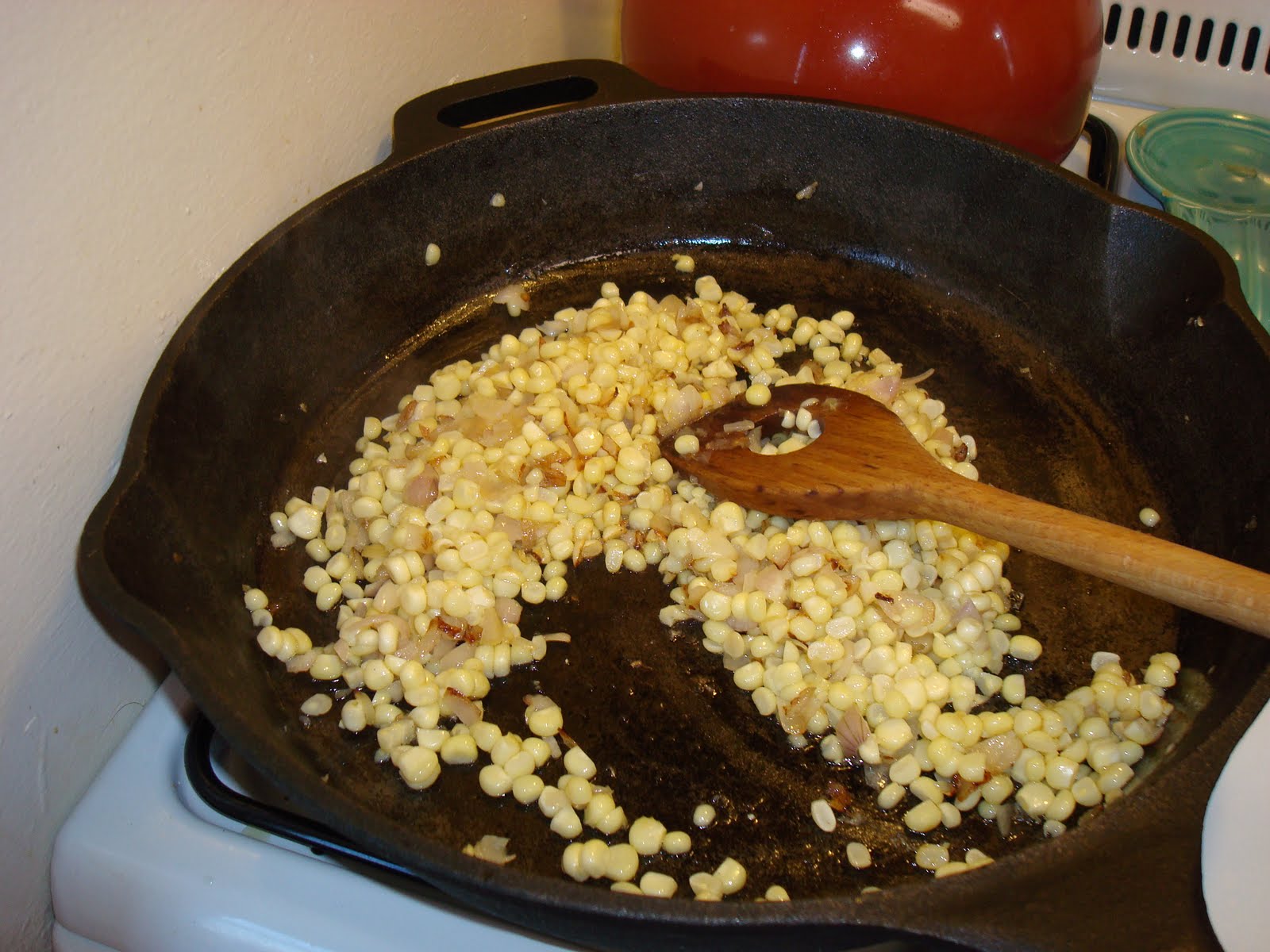
In a large saute pan, saute the shallots in the olive oil for about five minutes, and then add the corn. Saute for about five more minutes, and then add the peppers and saute for about another five minutes. The vegetables should have softened, but still have some crispness.


Chop the avocado into medium chucks and set aside.

Once the potatoes are ready, drain them and slice them in half. In a large bowl, combine the potatoes and shallots, peppers, and corn. Add the dressing, and then the tomatoes. Finally, add the avocado, and mix all together with salad tongs.

Put salad in refrigerator until room temperature or cold, depending on preference.

Keeps for several days in the refrigerator and tastes great cold!