Tuesday, June 28, 2011

Thai Stuffed Peppers

June Theme: International Food Issues & International Recipes


While I have to admit I can't completely vouch for the Thai authenticness of this recipe, I was drawn to it because of the mix of some interesting flavors for a stuffed peppers recipe, which I usually think of as being an Italian or all-American dish.


But the stuffed peppers have a completely different flavor in this case because of the cilantro, peanuts, and Thai flavors. I ate this with rice when I made it, because it does end up tasting like a lot of meat at once (so it could be interesting to add other vegetables to the pepper stuffing). Don't skip the fresh lime juice, which makes them taste really fresh!


Thai Stuffed Peppers

1 lb ground turkey
2 T Hoisin sauce
2 T soy sauce
1/2 C chopped peanuts
1 shallot, minced
3 cloves garlic, minced
1 T fish sauce
1/4 t ground back pepper
1/2 C chopped fresh cilantro
1 T ground or fresh ginger
5-6 large sweet peppers (I used sweet cubanelle peppers)
Juice of one lime

1. Combine the turkey, peanuts, shallot, garlic, fish sauce, black pepper, soy sauce, Hoisin sauce, lime juice, and cilantro in a mixing bowl.
2. Cut the peppers in half lengthwise. Remove the seeds and membranes.
3. Stuff the turkey mixture into the pepper halves, mounding the mixture slightly.
4. Bake at 350 degrees F, uncovered, in a lightly-greased pan for 35-40 minutes, until meat is cooked through.

Adapted from Crossroads Cooking

Tuesday, May 31, 2011

International Food Crises caused by Spikes in Food Prices

June Theme: International Food Issues & International Recipes

But a brief aside before getting to the actual topic...

So, first of all, my one-month hiatus from the blog accidentally turned into a three-month hiatus. Instead of trying to figure how that's possible, and how that much time went by, I'm going to focus on the fact that I'm excited to get back to the blog, and the whole monthly theme plan that I have been working on.


In the time since I last posted, I went on a month-long work trip to Indonesia, and one tiny blog-related thing came full circle: the image at the top of the blog is of rice paddies, and while I was in Indonesia I went on a hike outside of Jakarta through some amazingly beautiful actual rice paddies.


Even though I've been back for a few months, I've still been thinking a lot about my trip, and so it seemed like a good time to do a post on international food policy issues. And then with the next couple of posts, I'll post some internationally-inspired recipes!

And now to the topic at-hand: food prices.

Maybe you remember the news coverage on the global food crisis in 2007-2008; that was the first time I remember learning about some of the complicated causes of escalating food prices and the potential impacts.

That particular food crisis was blamed on factors including rising energy costs and an increase in demand for food brought on by a growth in the middle class in China and India. In addition, demand for biofuels in developed countries was also blamed, including by the World Bank; since biofuel production requires food sources as an input, theoretically their production competes with food resources and increases prices through an increase in demand.

Why does this matter? Even though households in the US are obviously also affected by increases in food prices, because households in developing countries spend a higher portion of their income on food, they are adversely affected. According to a 2008 NYT article, "Even the poorest fifth of households in the United States spend only 16 percent of their budget on food. In many other countries, it is less of a given. Nigerian families spend 73 percent of their budgets to eat, Vietnamese 65 percent, Indonesians half."

In the food crisis of 2007-2008, these stressors affected not only people's access to food, but led to social unrest; increases in food prices lead to riots in several countries, including Haiti and Egypt.

And now, upon observing high food prices in 2011, many have predicted that another food crisis is on the horizon. An article by Lester Brown in Foreign Policy names similar causes for this crisis as the one in 2007-2008, but adds that climate change-induced effects such as soil erosion, which shrinks production.

What can be done? Obviously this is an incredibly complicated issue, but suggested policy options to deal with this issue include convincing the US and EU to lesson subsidies and tax benefits for biofuel production, and programs to increase agricultural productivity in developing countries so as to decrease prices (see NYT 2008 article). In addition, it seems that legislation targeting climate change should be a long-term policy goal, with development programs that work on the effects of climate change on agriculture helping in the short term.

This policy topic is as bit harder to tie directly back to "your own table" (other than maybe not using biofuels and trying to limit climate change). For me, it's more of a reminder to think of ways to affect and change developed country agriculture policy, including biofuel policy, since it seems that this is one factor among the many complicated ones that combine to cause food crisis in developing countries.

Sunday, February 27, 2011

Brief Blog Hiatus

I am out of the country for work for most of March, so the blog will be on a brief hiatus! Back in April with more posts.

Garlic Cloves Confit

February Theme: Indulgence.


I'm packing to go on a work trip, so this will be short! And simple: garlic slow-cooked in olive oil-- and that is the whole recipe. And yet, this dish is really something in-and-of itself. Plus, it's very indulgent: it doesn't even really fit into any one meal, so you basically need to let yourself have an appetizer or snack of this in between your normal meals. Even though the flavor relies on just garlic, because of the way it's prepared, the flavor is unique. The garlic is slow-cooked to the point of being as spreadable as butter, and the flavor is earthy and rich. It's great alone on baguette, or added to a sandwich.


Garlic Cloves Confit

1/2 C peeled garlic cloves
About 1/2 C olive oil

Put garlic into a small heavy saucepan and add enough olive oil to cover garlic. Bring just to a simmer, reduce heat, and cook at a bare simmer until garlic is tender, about 25 minutes. Let garlic cool in oil.

The garlic keeps, in the oil, for up for two weeks, covered and refrigerated.

Monday, February 14, 2011

Gingerbread with Cheesecake Layer

February Theme: Indulgence.


I'm taking a little break from the policy theme (which I attempt to connect my recipes to, however tangentially) for the month of February to focus on a very important quality of food: richness.


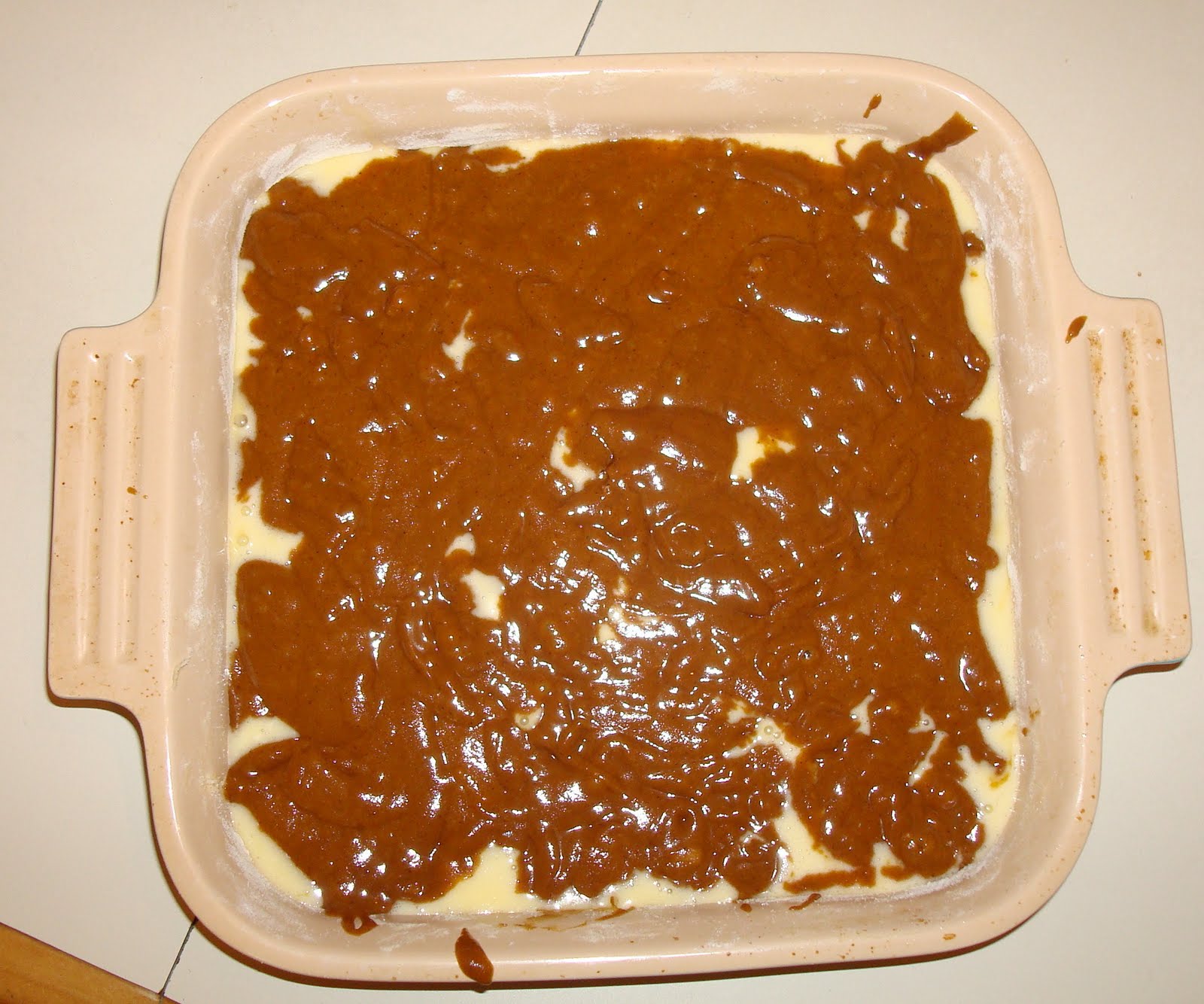
I love gingerbread, and this recipe allows you to eat it in soft, brownie-esqe form. To up the richness ante, these have a layer of cream cheese in the middle, which actually ends up seeming very crucial as it counter-balances the spiciness of the gingerbread. Delicious.


One note: the recipe calls for very hot water of 190 degrees F; I didn't take the temperature of the water I used, but microwaved it to about the temperature that you would for tea.

Gingerbread with Cheesecake Layer

Serves 6 to 8
Slightly adapted from The Splendid Table

Cheesecake Mixture
1 egg
4 ounces cream cheese
1/4 C sugar
2 t lemon juice
1/2 t vanilla extract
Gingerbread
2 C less 2 T unbleached all-purpose flour
1 t baking soda
Generous 1/2 t salt
1 T ground ginger
3/4 t ground cinnamon
1/4 t ground cloves
1/4 t cardamom
6 T unsalted butter, melted
3/4 C dark molasses
3/4 C very hot water (190 degrees F)
1/3 C packed dark brown sugar
1 large egg

1. Before starting the gingerbread, make the cheese mixture. Beat together the egg, cream cheese, sugar, lemon juice, and vanilla. Set aside.

2. Preheat the oven to 350°F. Butter and flour an 8-inch square light-colored metal or ceramic baking pan.

3. Make the gingerbread. In a medium bowl, whisk together the flour, baking soda, salt, ginger, cinnamon, cloves, and cardamom. In a large mixing bowl, beat together the butter, molasses, hot water, and brown sugar. When the mixture is almost frothy, beat in the egg, and gradually add the flour blend. Stir until thoroughly blended, but no more.

4. Pour half of the gingerbread batter into the pan. Drop spoonfuls of the cheese mixture over the batter. Then cover with the remaining gingerbread mix. Bake for 35 minutes, or until a tester inserted in the center of the cake comes out clean.

5. For a moist gingerbread, cool it in the pan on a wire rack. For a drier consistency, cool the gingerbread in the pan for 10 minutes; then turn it out of the pan and set it on the rack to cool.

Tuesday, February 1, 2011

Slow-Cooked White Bean Gratin

[Belated] January Theme: Making Beans, an Efficient Energy Source, Taste Richer Than They Really Are


Upon ringing in 2011 I had lots of new thoughts about the blog; about new recipes to try, and about how to integrate the recipes better with the food policy ideas... and then somehow the whole month of January went by. Mostly somehow sucked up by work. But, moving on. What I want to try to do is have changing umbrella themes or topics that the recipes fall under, and change it month to month.

So even though January is actually over as of today, I DID actually make something to fit into the new plan this month, I'm just super late in posting it, and so am going to pretend it's not quite February yet.


My idea for January was to do some really simple recipes to go along with the clean-slate feeling of a new year, and also tie this back to a past post about the environmental effects of eating meat by showing some satisfying, interesting recipes with one of the most efficient forms of protein that you can use: beans. Plus, beans seem like a good ingredient to use at the start of a new year, when lots of people are resolving to spend less money, because they are so cheap, but can be really good when played-up.

But beans can seem kind of boring. I tried to get around that with this recipe, which requires slow-cooking the beans to make them tender and more flavorful than usual, and then putting them in a gratin, which makes the white beans taste surprisingly rich, and like a dish in and of themselves.


Slow-Cooked White Bean Gratin
Adapted from Gourmet

1 pound (2.5 C) dried white beans
4 cups onions, chopped
5-6 cloves garlic, peeled
2-3 sprigs rosemary
10 C water
1 bay leaf
1 T salt
2 carrots, diced
1 T olive oil
3 t white wine vinegar
1 T garlic cloves, minced
salt and pepper to season
1 C bread crumbs (I used whole wheat)
1/2 C Parmesan cheese, shredded
1 C Gruyere cheese, grated

1. Put beans, water, rosemary, bay leaf, and garlic in 5-quart heavy pot. Cover and slowly bring to a simmer over low heat, which will take about one hour. Then simmer beans until tender but not mushy, about 35-45 minutes. Remove from heat and let cool, covered, for about 15 minutes.
2. Drain almost all cooking liquid from beans but while reserving cooking liquid. Discard rosemary sprigs and bay leaf and mash any intact garlic cloves into beans. Add salt.
3. In a saute pan, use 1 T olive oil and saute chopped onions, garlic, and carrots for 10-15 minutes, until tender.
4. Combine 1 C of cooked beans, 1.5 C of left-over cooking liquid, 1 T olive oil, white wine vinegar, and salt to taste in a blender or food processor and puree. In large bowl, stir puree into remaining whole beans, and then add in onions, garlic, and carrot mixture. Pour mixture into 3-quart baking dish or other shallow baking dish.
5. In small bowl, mix together bread crumbs, Gruyere, and Parmesan, and sprinkle over gratin. Bake gratin at 425 degrees F until top is browned, about 20 minutes.

Wednesday, December 22, 2010

Lime Macaroons Dipped in Dark Chocolate


You can't get something much richer than a macroon dipped in dark chocolate. So I was trying to think of a way to add a different flavor to all of the sweetness and richness. What I came up with is this recipe for macaroons with lime, still with the dark chocolate. And they're good! They're also kind of interesting as a holiday cookie, because lime is a tropical or summer flavor, but it's kind of nice to each something zesty this time of year.


Macaroons are pretty straight-forward and easy to make. I did have a couple of issues with this recipe, though. For one, I had one baking sheet of cookies on the bottom rack of the oven, and those burnt. So try and put both baking sheets on the top rack of the oven, or back in two batches. I also didn't use cooling racks and left the cookies to cool on the baking sheets, and they ended up getting a little stuck to the pans. So definitely put them on racks when you take them out of the oven.


Happy Holidays!

Lime Macaroons Dipped in Dark Chocolate
Makes about two dozen

1 egg
2/3 C sugar
1 t vanilla extract
2 1/2 C sweetened shredded coconut
1 T lime zest
juice of 1 lime
approx. 1 4-ounce bar of dark chocolate

1. Preheat oven to 350 F. Line baking sheets with parchment paper or grease.
2. In bowl, wisk egg and beat until light. Gradually beat in the sugar, vanilla, lime zest, and lime juice. Continue beating until light and fluffy. Fold in the coconut.
3. Drop batter by heaping teaspoons onto the baking sheets, making mounds and spacing about 1.5 inches apart.
4. Bake for 12-15 minutes on top rack of oven. Turn off heat and let cookies dry in the oven for 10 minutes. Transfer to racks to cool. The insides should be soft while outsides crisp.
5. Melt chocolate in microwave or on stove top. Once macaroons are cool, dip the flat part of each in chocolate and transfer to waxed paper. After dipping all macaroons, refrigerate until chocolate has hardened.