Wednesday, March 6, 2013
Ginger-Melon Hydrating Recovery Juice
A short post with another running-related recipe. This is a quick juice that you can make in a blender using cantaloupe (or another melon) and ginger. Melons have a higher glycemic index than other fruits and high water content, and ginger has anti-inflammatory properties, so they make a good post-running combination. Plus, the ginger is really refreshing. Use more or less ginger based on your preferences and enjoy! I think this could also be good mixed with some sparkling water for carbonation.
Ginger-Melon Hydrating Recovery Juice
From realbuzz.com
2 chilled melons, skinned and seeded
1-2 T skinned and chopped ginger
8 crushed ice cubes
Put all ingredients in a blender and blend until smooth.
Labels:
drink,
quick,
running training recipes,
vegan,
vegetarian
Thursday, February 28, 2013
Stovetop-Baked Eggs over Vegetable Stew
I have been running a lot recently, since I'm training for a half marathon in mid March. Even though I've been jogging since high school as a workout, this is really the first time that I've worked on increasing my mileage and the first period I've ever regularly run more than four or five miles at one time. So I've been hungry. I'm running with a training organization, Team in Training, and we have our long training runs early on Saturday mornings, so I've gotten into a pretty regular routine of coming home and making a huge brunch on Saturdays.
I thought it could be an interesting tangent to add running recipes to the blog- the longer I do this the harder of a time I have of coming up with new ideas, so I thought this could be a good new topic! So watch for similar posts in the future.
I was curious, first, to do a little research on what a good post-running meal should include. None of it is super surprising, but I found some good reminders.
Cooking After a Long Run
Post-running recipes should have a couple of main components:
Carbohydrates
Protien
Antioxidants
Says Discovery Health, "A run that lasts an hour or more taxes your body in such a way that you need to give it carbohydrates and protein in a particular proportion -- ideally, a 4-to-1 ratio of carbs to protein -- that will maximize immune function while restoring energy and rebuilding your muscles better than before."
So, protein and carbs are obviously both very important. I thought it could be a good challenge to come up with a vegetarian protein-rich recipe, since a vegetarian protein is typically more environmentally-friendly than a meat protein.
The resulting recipe was a modification of something I'd read about on another cooking blog and had been wanting to try. It's heavy in eggs and vegetables, which is good:
Eggs: From Runner's World: One egg fulfills about 10 percent of your daily protein needs. Egg protein is the most complete food protein short of human breast milk, which means the protein in eggs contains all the crucial amino acids your hard-working muscles need to promote recovery. Eat just one of these nutritional powerhouses and you'll also get about 30 percent of the Daily Value (DV) for vitamin K, which is vital for healthy bones.
Vegetables: Research shows that eating a combination of antioxidants [found in vegetables including bell peppers and onions], such as beta-carotene and vitamin C, may lessen muscle soreness after hard interval workouts by reducing the inflammation caused by free-radical damage (from Runner's World).
The recipe is pretty simple once you have everything chopped up, and an added bonus is that it makes a LOT. Which is nice when you're using it as a post-running meal, since you can eat a lot and still have leftovers. I ate it with a sliced wheat baguette, since I felt like it needed something to sop up some of the liquid and balance out the flavor. I was really happy with it in the end- basically a nice way to eat a lot of different types of vegetables at once, and good flavor from the stewing. I think you could really do some creative, things, though, and use any vegetables or cheeses you have around.
adapted from katechristensen.wordpress.com
1 onion
1 red bell pepper
1 8-ounce package of baby Portobello mushrooms
4-5 cloves of garlic, chopped and mashed
2 medium zucchini, chopped
1 T hot red peper flakes
4 eggs
1.5 C shredded parmesean cheese
about 6 C chopped baby arugula
"jot" of half and half (a few tablespoons)
sprinkle of paprika
salt and pepper
1-2 T olive oil
1. Chop the onion, mushrooms, and red peper. Saute these with the chopped garlic in a large oven-proof skillet with the olive oil until vegetables have softened but are not fully cooked.
2. Add the chopped baby arugula and let it cook until it wilts down to almost nothing. Season with the paprika, red hot pepper flakes, and salt and pepper to taste.
3. Stir and let simmer uncovered for five to seven minutes, until the vegetables are tender, and then sprinke parmesan cheese over it in a layer.
4. Preheat oven to 350 degrees F.
5. Crack four eggs one by one onto the surface of the vegetables and pour a jot of half-and-half over each egg yolk.
6. Remove the skillet from heat and put in the oven. Cover and let bake until the egg whites are just barely set and the yolk is still runny.
Serves approximately six.
**I ate this with some baguette, which worked really well. This soaked up some of the liquid from the dish and balanced out the flavor and richness of the eggs and cheese.
Sunday, December 16, 2012
"Foodie Getaway" Union Market in Northeast DC
Standing out for its shiny new facade and golden-lit aisles among warehouse buildings that probably haven't changed much in decades, it's easy to see why Union Market is called a "foodie getaway." They're probably referring to more than just the location, since it's also trying to carve out a niche type of food options, mainly artisanal grocery items and small-scale restaurants. After hearing about it for the past few months as a unique place to shop and eat, I checked it out last weekend.
Union Market just opened this
past September near Florida Avenue and 5th Street NE in a building
originally built in 1967 as an indoor food market and used for several
decades as a wholesale food retail space. It has now been revitalized as
a food market, event space, and series of restaurants, all contained in
the wide aisles of the industrial space.
Walking up to the Market gives you a sense of its history, since it was actually not on Florida Avenue, but behind several rows of other warehouses.
Inside, my first impression was that it was a welcoming space with wide aisles consisting of different small vendors - either stands or counters selling grocery items, or small restaurant counters. I really liked the concept of different small restaurants in one place, but that is something I'll have to come back for next time; when I went, I was actually assuming that it was much more of a market, and was hoping to find some unique and hard-to-find cooking ingredients. There wasn't as much of that as I would have hoped, although I was able to find some spices for Thai cooking that I looking for.
All in all, there was a lot more there than I had time to try, and since it's only been open a few months, I will definitely try and go back sometime. When I was there, the woman I bought spices from said that they are planning to eventually open a beer garden on the second floor, which would be a cool addition. But to give you a better sense of what you'd find if you went, a partial list of businesses I saw:
- Diner restaurant counter
- Wine bar
- Home decor and specialty food items shop
- Spices shop
- Meat counter
- Korean taco counter
- Hot sauce kiosk
- Artisanal honey kiosk
There were a
few things that I felt could be improved. For one, I felt like the
market part could have been expanded and could have had more unique
options. It's not necessarily that unique to sell artisanal
cheese; there are a lot of places in DC where you can buy that. But I
think if they had expanded options, it would make it more worth it to go
there. It would also be interesting to get away a bit from the typical
"foodie" options of fresh ingredients and lots of meats and cheeses, and
have unique options in terms of ethnic foods or other food ingredients
that are hard to find at typical grocery stores.
All in all, though, go if you get a chance! But if you go, maybe just don't buy into the developer's description (bordering on condescending to the neighborhood?) of the adventure that it is to go there because of the neighborhood it is in:
"Located in the middle of a patchy wholesale district where few shoppers have tread for a generation, getting there is part of the adventure... McLean thinks people are willing to pay extra for the story they can tell about exploring an industrial district of Washington in search of a foodie paradise" (Washington Post).
You don't really experience the industrial district, since Union Market is completely different than all of those types of businesses that are around it, other than the fact that the building its in used to be a part of that. Developers have to make up a story I suppose. But I'm looking forward to seeing what else comes to this space in the name of good food!
Monday, October 29, 2012
"Climate silence" in the 2012 Presidential Election
The Presidential election is a week from tomorrow, and I'm writing this from my house in DC with Hurricane Sandy advancing outside my window. A hurricane that is probably partially caused by the one-degree increase in sea temperatures since the 1970s. So it seemed like the perfect time to ponder something that has confounded me about the campaigns of both Romney and Obama, particularly during the debates: the lack of discussion of climate change as a problem the US needs to address.
Watching the second Presidential debate, I was thrown by the part of the debate devoted to energy. While I recognize that during an election climate change might not be enough of a hot-button issue that a candidate is about to include it as a major campaign issue, I had assumed that, in 2012, climate change was enough of a known global issue among voters that it would be awkward and backwards-seeming to not even acknowledge it in a conversation about energy. Instead, both Obama and Romney promised to enhance US oil and coal production. Which, seen through the lens of climate change policy, is a very confusing goal.
Some questions:
Is climate change usually discussed in Presidential debates? Interestingly, the "climate silence" of this election is somewhat of a departure from the recent past, as this is the first time since 1988 that climate change has not been mentioned in the series of Presidential debates. During the 1988 Presidential debates, the candidates were asked about climate change for the first time, following a famous Congressional testimony on climate change by James Hansen.
Why aren't Romney or Obama discussing it more? While Obama does mention climate change in public statements and speeches, both candidates failed to mention in any of the three debates. For one, candidates probably don't feel that they should give a lot of airtime to the issue because the economy is the issue that polls as the first priority to voters. Even when questioned about energy directly in the debates, Romney and Obama both seem to want to ensure that they will protect coal-related jobs and keep the cost of gas down during a recession. As has been documented in several news articles, neither candidate is willing to acknowledge the negative side effects of fossil fuel use when such a sentiment could suggest loss of jobs or rising household costs.
There is something surreal, though, about living in the era of climate change, and hearing candidates try and one up each other to be more of "friend to coal." As Will Oremus reported in Slate, during the debate, "when Romney accused Obama of not being 'Mr. Oil or Mr. Gas or Mr. Coal,' the president defended his record of opening public lands for oil drilling and fired back that Romney was no great friend of coal either."
While I don't want to diminish the economic concerns of those whose employment is based on fossil fuel production, or those for whom an increase in gas prices would present a major obstacle, left unaddressed climate change will likely have very significant economic consequences, especially for the poor. As the United Nations Intergovermental Panel on Climate Change (IPCC) concluded regarding the impact of climate change, "It is the poorest of the poor in the world, and this includes poor people even in prosperous societies, who are going to be the worst hit."
![]() |
| source: http://www.latimes.com/business/money/la-fi-mo-hurricane-sandy-washington-20121029,0,3333190.story |
Some questions:
Is climate change usually discussed in Presidential debates? Interestingly, the "climate silence" of this election is somewhat of a departure from the recent past, as this is the first time since 1988 that climate change has not been mentioned in the series of Presidential debates. During the 1988 Presidential debates, the candidates were asked about climate change for the first time, following a famous Congressional testimony on climate change by James Hansen.
Why aren't Romney or Obama discussing it more? While Obama does mention climate change in public statements and speeches, both candidates failed to mention in any of the three debates. For one, candidates probably don't feel that they should give a lot of airtime to the issue because the economy is the issue that polls as the first priority to voters. Even when questioned about energy directly in the debates, Romney and Obama both seem to want to ensure that they will protect coal-related jobs and keep the cost of gas down during a recession. As has been documented in several news articles, neither candidate is willing to acknowledge the negative side effects of fossil fuel use when such a sentiment could suggest loss of jobs or rising household costs.
There is something surreal, though, about living in the era of climate change, and hearing candidates try and one up each other to be more of "friend to coal." As Will Oremus reported in Slate, during the debate, "when Romney accused Obama of not being 'Mr. Oil or Mr. Gas or Mr. Coal,' the president defended his record of opening public lands for oil drilling and fired back that Romney was no great friend of coal either."
While I don't want to diminish the economic concerns of those whose employment is based on fossil fuel production, or those for whom an increase in gas prices would present a major obstacle, left unaddressed climate change will likely have very significant economic consequences, especially for the poor. As the United Nations Intergovermental Panel on Climate Change (IPCC) concluded regarding the impact of climate change, "It is the poorest of the poor in the world, and this includes poor people even in prosperous societies, who are going to be the worst hit."
Sunday, September 23, 2012
Chorizo, egg and rosemary breakfast risotto
The weather has been autumnal here in DC, and as I was thinking about the weekend at the end of this week, I started to crave a really hearty brunch. After coming across a couple of recipes for savory breakfast risottos, as indulgent as that sounds (and is...), I couldn't resist. Colder weather + breakfast ingredients + risotto makes tons of sense to me.
I wound up combining two different breakfast risotto recipes, particularly because I wanted to make one that had a more autumnal flavoring, which to me means herbs like rosemary and sage.
The resulting flavor is interesting, because it's a bit like eating porridge, and a bit like eating a favorite comfort food, with the rosemary, roasted tomatoes and chorizo. I also love the addition of the egg on top - although it doesn't take away from the richness of the dish, the egg is such a different texture, and has such a bland (in a good way) flavor, that I think it makes it a lot more interesting. While it's rich, it's great for when you feel like something substantive for breakfast; it made a great post-run brunch this weekend.
This is also not the quickest of recipes. So make it on a weekend when you have some extra time, and want to dig into a cooking project. The reward is that it makes a pretty big batch, so you should have leftovers.
(Try to ignore the imperfect job I did on this sunny-side-up egg... which turned out to more of just a fried and slightly scrambled egg.)
Chorizo, egg and rosemary breakfast risotto
Adapted from the Smitten Kitchen and Jamie Oliver recipes
Serves: Approx. six
6 cups low-sodium chicken stock or vegetable broth
3-4 links of chorizo sausage
3-4 tablespoon olive oil
2 large or 3 smaller leeks, quartered lengthwise, cleaned of grit, and chopped small
1/2 small onion, finely chopped
2 cups arborio rice
1/3 cup dry white wine or vermouth
6 small Roma tomatoes or other small tomatoes
4 sprigs fresh rosemary
1 cup finely grated fresh Parmesan cheese, plus extra for garnish if desired
Salt and freshly ground black pepper
approx. 6 large eggs; one per serving
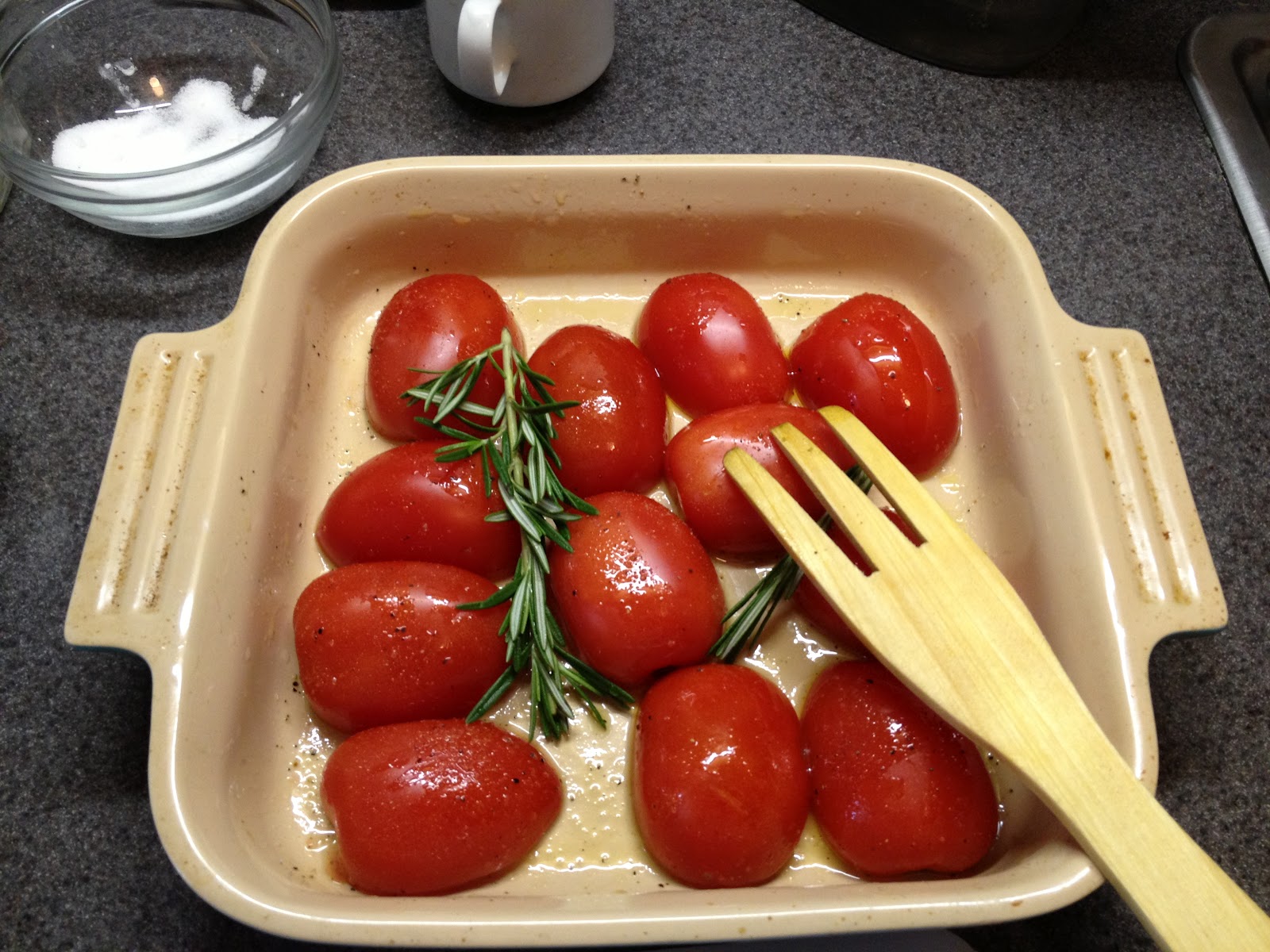
1. First, start the tomatoes roasting. Heat the oven to 350 F, wash the tomatoes, cut then in half, and place skin up in a roasting dish. Coat with olive oil, salt, and pepper. Throw in a spring of rosemary and cook for about 30-35 minutes. After tomatoes are finished, set aside to cool and then cut into chunks, discarding rosemary.
2. Place stock or broth in a small-medium saucepan over very low heat on a back burner and keep it heated until steaming, but not so hot that it simmers.
3. Heat a second medium saucepan (3 quarts) or skillet over medium heat. Add chorizo, leeks, and rosemary, and cook for 10-12 minutes. Leeks should be softened and mostly tender. Next remove all from pan and set aside, but leave pan with sausage flavoring. Transfer to bowl with bacon and set aside, leaving stove on.
4. Add olive oil to pan and cook onions until translucent and tender, about 5 minutes. Add rice and cook sauté until faintly toasted, about 4 minutes. Add wine or vermouth and cook until it almost disappears, about 2 minutes. Ladle 1 cup of hot broth into the rice mixture and simmer until it absorbs, stirring frequently. Add remaining broth 1/2 cup at a time, allowing broth to be absorbed before adding more and stirring frequently until rice is al dente, about 25 to 30 minutes.
5. From smitten kitchen regarding the risotto's consistency: "What you’re looking for in well-cooked risotto is a creamy but loose dish. When ladled onto a plate, it should spill into a creamy puddle, not heap in a mound. You might need an extra splash of broth to loosen it."
6. When risotto is the desired consistency, add the cheese and chorizo, leeks and rosemary mix, and then add the chopped roasted tomatoes.
7. Then, quickly, in a small skillet, heat a olive oil over medium-high and swirl it to coat the pan. Crack one egg into the skillet, season with salt and pepper and reduce heat to medium. Cook egg sunny side up. Cook one egg per serving of risotto.
8. To serve, garnish each serving of risotto with a bit of Parmesan cheese, and lay the egg on top.
Saturday, August 11, 2012
Debate over Corn for Ethanol versus Food
photo source: http://www.earthyreport.com/site/midwest-drought-worsens/
Summer is going so quickly and I can't believe that it's already almost mid August! I'm getting ready to go to Minnesota for my summer vacation at the end of this week, and but I wanted to do a quick post about an interesting article I just read on ethanol policy in the US, a topic that is especially relevant given what is going on in the Midwest this summer: massive droughts that are destroying corn (and soybean) crops.
The authors of this article in the New York Times argue that ethanol-supporting energy policies in the US are making the effects of the drought worse in terms of food prices and hunger, even outside of the US.
This is a complicated issue, since promotion of ethanol production has some attractive environmental rationals, mainly that they potentially lessen the US's dependence on gasoline and that ethanol is more environmentally friendly and lowers carbon dioxide emissions. This article, though, argues that ethanol from corn is not worth this diverting of corn from food, since corn yields less energy than other sources of biofuels, and also leads to fuel with less energy than gasoline.
The authors suggest that the ethanol standards (which require a certain level of renewable fuel production) are exacerbating the effects of the droughts. Corn prices would have likely already increased due to a smaller corn crop in the US due to the drought, but with a high percentage of that already small crop of corn going to ethanol production due to the ethanol regulations, there will be even less corn for food.
A detail I was surprised about were the statistics on where corn produced in the US ends up - according to the article, only around 15 percent of the US corn crop goes toward food consumption:
"More than one-third of our corn crop is used to feed livestock. Another 13 percent is exported, much of it to feed livestock as well. Another 40 percent is used to produce ethanol. The remainder goes toward food and beverage production."
The implications of higher prices for corn could be far-reaching, given the role that corn plays in global food markets, according to the article. The high price of corn, leading to a higher price of food, could lead to less food security more hunger throughout the world.
This isn't the most cheery summer subject, but I think it's a good example of the importance of looking at the trade offs with any "pro-environment" policy. I'm not sure exactly what I think of ethanol, and it's hard to imagine any alternative fuel getting a very good start without government support and intervention, since gasoline will probably always be cheaper at first from a consumer's perspective. Articles like this do make me wonder, though, if corn is the best biofuel source given its role in relation to food prices and hunger.
Saturday, June 23, 2012
Make your own cold-brewed iced coffee
You might be thinking "an iced coffee recipe? What is there to explain?"
And on the part of the ingredients, you'd be right. Obviously iced coffee is... cold coffee and ice, and whatever else you want to add to it.
But I recently bought a cold press coffee maker, and it has been a definite win-win situation: better iced coffee, one, and also cheaper and more environmentally friendly (compared to buying iced coffee at a coffee shop).
It's hot in DC all summer long, and this week was our first hot, in-the-90's, gross week. At times like this, I end up buying coffee from coffee shops a lot more than during the winter, both because I don't like the iced coffee that I made at home as much, and also because the way I was doing it before (cooling down hot coffee by putting it in the refrigerator) took longer to do every day than buying it somewhere.
Process
I bought the Toddy T2N Cold Brew System for about $35 on Amazon. It's an interesting process to do the first few times: you put what seems like a lot of coffee (12 ounces with several cups of water) into the top chamber, which has a filter and a plug at the base, and let is sit for at least 12 hours at room temperature. After 12 hours, you take the plug out of the bottom of the chamber, and the water filters through into a glass carafe. That part takes a bit of planning ahead, but what is produced is actually a concentrate that you later add water to. You should be able to use the amount from one batch for at least a week, and it keeps for up to two weeks in the refrigerator. (I'm not going to write super specific directions for the process, since it comes with instructions, and if you buy a different brand the process is probably slightly different.)
After that, you have a carafe of the concentrate that you can keep in the refrigerator and make iced coffee all week, which is great. When I made mine, I mixed about 1/3 C of the concentrate with enough ice, water, and milk to fill a large pint-sized glass. I like a lot of milk in it without sugar, but you can add whatever you want to it!
The coffee itself is delicious. I think that iced coffee made from cooled-down hot coffee turns out fairly bitter tasting, and with the cold press it seems to be much smoother tasting.
Cost & Environmental Factors
The first time I did this, I wasn't sure if making iced coffee this way was going to be cost effective, because you use more beans per cup than you would for hot coffee. But after seeing how many cups you can get out of the concentrate, and shopping around for some cheaper coffee, I think that the cost is actually really reasonable, especially considering that I think it tastes better. I found a couple of packages of 12-ounce coffee for five to seven dollars that was still pretty good quality, and got around seven servings out the concentrate that that produced. (I didn't include the cost of the cold press in the calculation, but you can see how it would be pretty quickly recovered.)
| Cost: About $4 |
| Cost: $0.70 to $1.00 (plus milk/sugar if added) |
Lastly, there is an environmental reason to make your own iced coffee: if you've been buying your iced coffee from a coffee shop, you have to throw away the cup after each one. By making it yourself, you're skipping out on the waste that comes from the cup! You can even find a travel re-useable iced coffee glass with a straw at a lot of places - I bought the one in the picture at the top of the post at Target last summer. As I wrote about in a previous post, avoiding using food packing as much as possible has multiple environmental advantages.
Subscribe to:
Posts (Atom)